
Int'l Academy of Oral Medicine & Toxicology
Safe Mercury Amalgam Removal Technique

Clifford / MELISA material reactivity
AAO-certified ozone protocol
847 practitioners verified against 12 biological dentistry criteria — SMART protocol, biocompatibility testing, ceramic burs, and ozone therapy.
Credentials
Audit.
Not every dentist who calls themselves "holistic" has earned the right to the term. These three questions separate certified practitioners from marketing copy.
Int'l Academy of Oral Medicine & Toxicology
Int'l Academy of Biological Dentistry & Medicine
American Academy of Ozonotherapy
Huggins Applied Healing Protocol
Is your dentist a current IAOMT member?
The International Academy of Oral Medicine and Toxicology sets the global standard for mercury-safe and biologically informed dentistry. Membership requires ongoing continuing education and adherence to published protocols.
Have they completed formal SMART certification?
SMART (Safe Mercury Amalgam Removal Technique) certification is separate from IAOMT membership. It requires a dedicated training course and authorizes the dentist to be listed in the IAOMT Worldwide Directory.
Do they hold IABDM membership or PROTECT Protocol training?
The International Academy of Biological Dentistry and Medicine's PROTECT Protocol adheres to OSHA guidelines and exceeds standard of care in most states for amalgam removal. Dual certification signals deeper commitment.
Directory Filters Applied
Protocols
Audit.
The SMART protocol is 19 steps. Most dentists perform 3. These questions expose the gap between a practice that "does mercury-safe" and one that actually does it.
Non-latex nitrile rubber dam placed and sealed
External O₂ via nasal mask for patient
High-volume air filtration in operatory
Amalgam sectioned into large chunks — small carbide drill
Post-removal rinse with charcoal / chlorella slurry
Staff protective equipment: gown, gloves, mask, eye protection
Patient draped with full-body barrier
Amalgam waste disposed per EPA guidelines
+ 11 additional steps per IAOMT specification
Does your dentist use a rubber dam during amalgam removal?
IAOMT SMART protocol requires a non-latex nitrile dental dam, properly sealed, to prevent mercury vapor and particulate from entering the patient's oral cavity and airway. No dam = no SMART compliance.
Do they provide external oxygen or clean air via nasal mask?
The patient must not inhale mercury vapor during removal. SMART requires external air or oxygen delivered via nasal mask throughout the procedure. This is non-negotiable and verifiable by asking the office directly.
Is high-volume air filtration running in the operatory?
Each room where amalgam is removed must have a high-volume air filtration system capable of removing mercury vapor and amalgam particles. A standard dental suction system is insufficient — look for dedicated mercury vapor filtration.
AAO-certified ozone therapy for cavity preparation, infection control, and post-extraction socket sterilization — without chemical agents. Verifiable through American Academy of Ozonotherapy certification.
Dissimilar metals in the mouth generate measurable electrical currents between restorations. Verified biological dentists conduct full oral toxicology evaluation including galvanic current testing as standard intake.
Materials
Audit.
Every material placed in your mouth becomes part of your biology for decades. Verified practitioners test before they treat — not after a reaction forces the conversation.
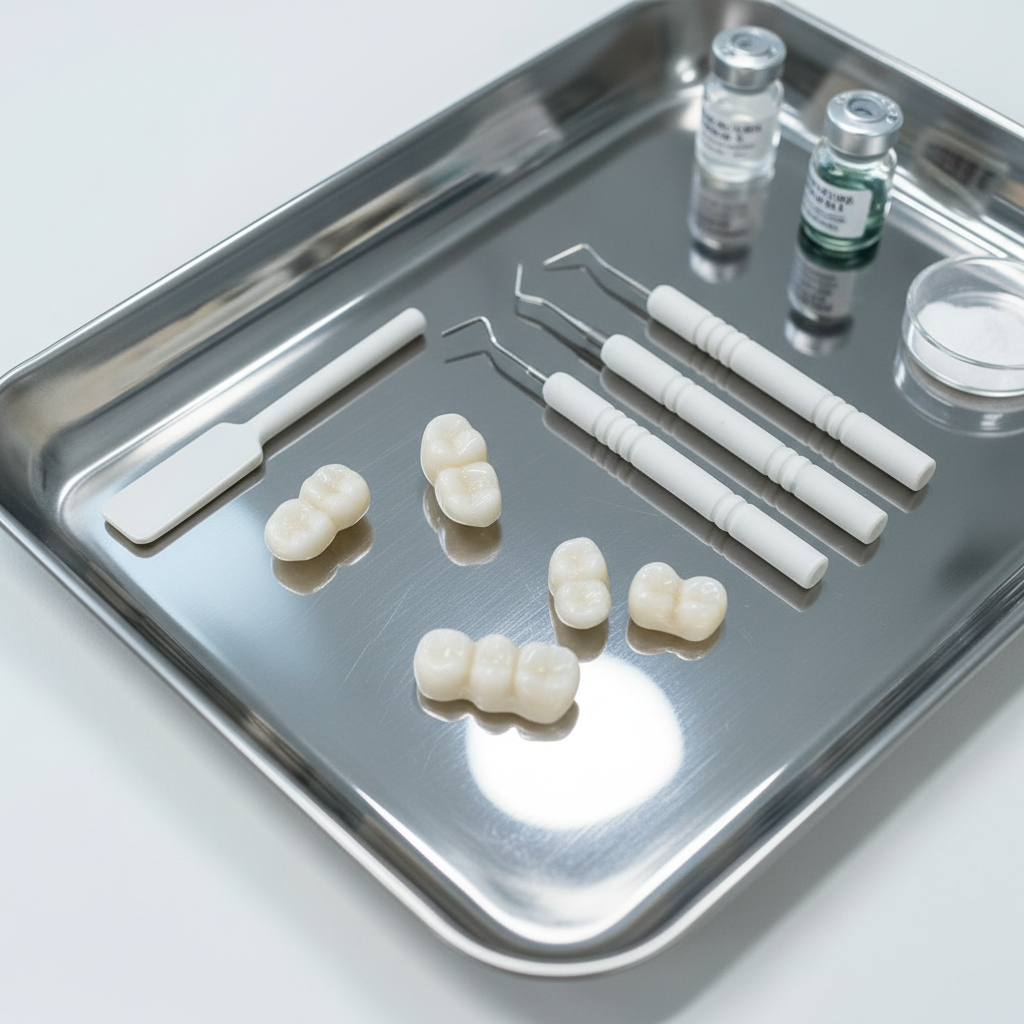
Does your dentist test material biocompatibility before placing any restoration?
Over 2,000 dental materials exist across 16,000+ branded products. Biocompatibility testing — Clifford Materials Reactivity Test or MELISA blood test — identifies which materials your immune system will tolerate before a single restoration is placed. Without this test, material selection is a guess.
Do they use ceramic burs for all tooth preparation?
Ceramic burs generate significantly less heat and friction than conventional carbide burs, preserving pulp vitality and reducing thermal stress on the tooth. Their use is considered standard of care in biological dentistry and is a verifiable practice.
Are zirconia or ceramic implants offered as the default metal-free option?
Zirconia dental implants are metal-free, non-toxic, highly biocompatible, and resist bacterial adhesion — reducing peri-implantitis risk. Research shows osseointegration comparable to titanium, without the ~1–3% titanium allergy risk identified via MELISA testing.
Metal-free, biocompatible, osseointegrates without allergenic risk
Biocompat test required — resin components vary by brand
No metal, no galvanic current, excellent aesthetics
MELISA test recommended — 1–3% allergy rate, corrosion risk
50% mercury by weight — not placed by any verified practitioner
Lab Partners
Audit.
A biological dentist's commitment to biocompatibility is only as strong as their laboratory chain. Verified practitioners source from testing labs and fabrication labs we've audited directly.
Blood draw at dental office — serum specimen collected
Specimen shipped to Clifford or MELISA testing facility
Lab screens against 16,000+ branded dental products
Patient-specific compatibility report returned to dentist
Only compatible materials placed — no immune system surprises
Does your dentist use Clifford or MELISA testing for material reactivity?
The Clifford Materials Reactivity Test (CMRT) screens dental materials against the patient's serum. The MELISA test is a delayed-hypersensitivity blood test that identifies reactions to titanium implants, metal bridges, amalgam, and other materials. Both require a blood draw at the dental office and return a patient-specific compatibility report.
Do they partner with a ceramic-only dental laboratory?
Verified practitioners source restorations from labs that produce only metal-free, ceramic-based prosthetics. This eliminates the risk of trace metals entering the restoration chain and ensures the final product matches the biocompatibility test results.
Patient Rights
Audit.
The final filter is consent and transparency. A practitioner who won't put their protocol in writing doesn't belong in this directory. These are your non-negotiable rights.
Every material, protocol step, and known risk disclosed in writing before you open your mouth.
Your CMRT or MELISA report is your record. You receive a copy before any restoration is placed.
No verified practitioner will pressure you into a material flagged by your biocompat test.
You may request written documentation of which SMART steps will be performed during amalgam removal.
IAOMT does not recommend amalgam removal for pregnant or breastfeeding patients. Any verified dentist will honor this without question.
All materials used, batch numbers, and lab provenance are recorded and available to you on request.
Does your dentist provide written informed consent covering all materials, protocols, and known risks before any procedure begins?
Informed consent in biological dentistry goes beyond standard dental consent. It must include: the specific materials to be used and their biocompatibility test results, the full SMART protocol steps being followed, known risks of the procedure, and your right to decline any material or step. If consent is verbal-only or covers only standard risks, the practice is not operating at a verified biological standard.
The 12-Point Checklist for Choosing a Biological Dentist
Every question from this audit, formatted as a printable checklist. Bring it to your first consultation. A verified biological dentist will answer every item without hesitation.
Search Verified Practitioners
Every practitioner in this directory has been audited against all 12 criteria. Use filters to match your specific health needs.
Showing practitioners who match 2 active filters: IAOMT Member, SMART Certified

Dr. Sarah Chen, DDS

Dr. Marcus Webb, DMD

Dr. Priya Nair, DDS
847 verified practitioners across 38 states